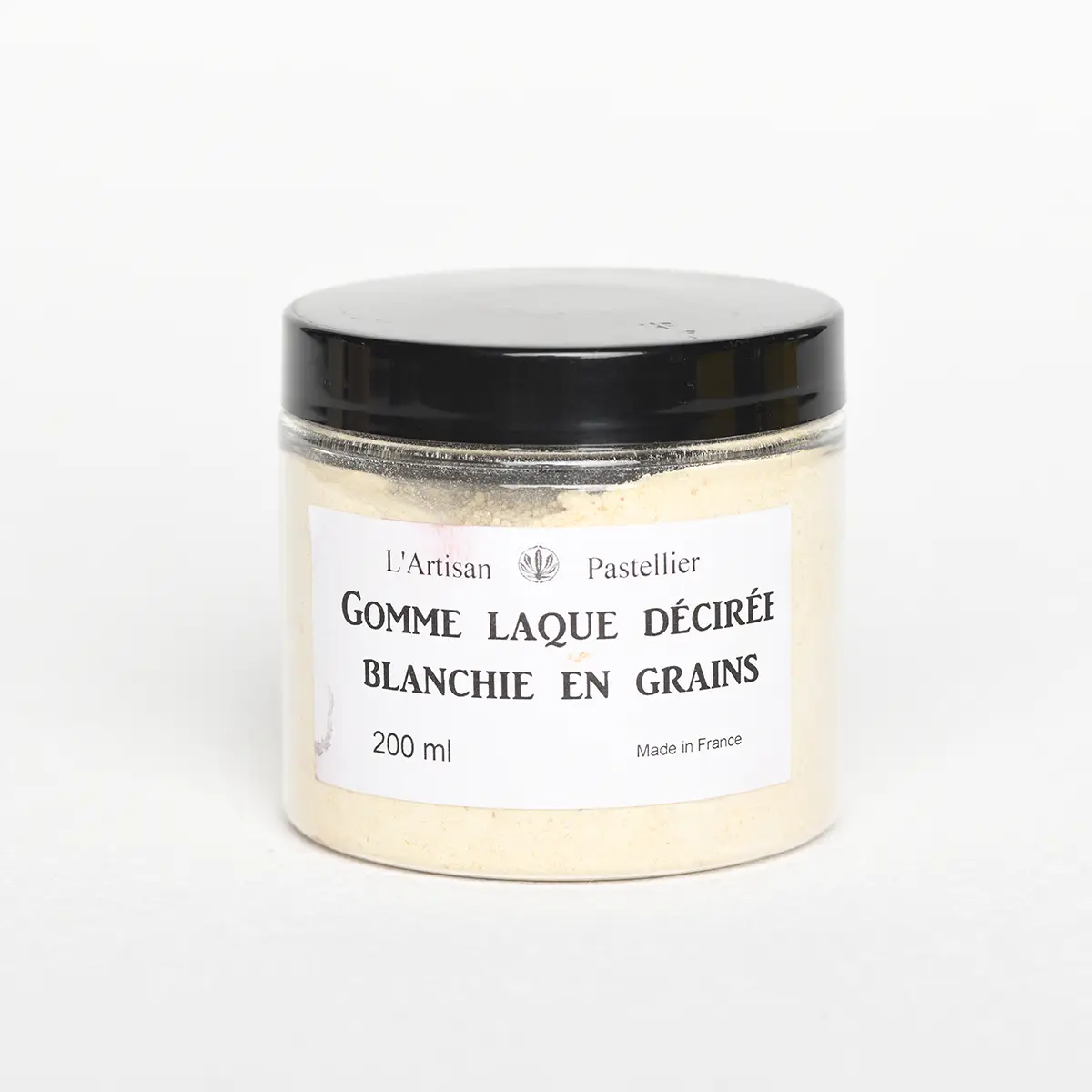
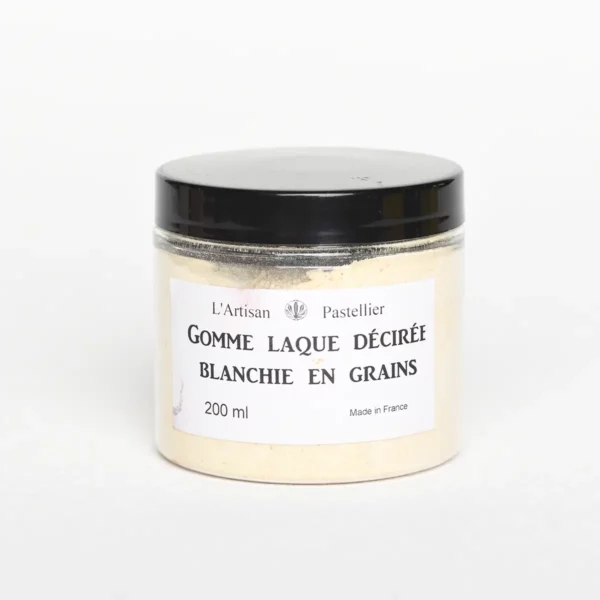
Bleached, wax-free shellac from L’Artisan Pastellier
Price range: €15.00 to €24.00 Including tax
L’Artisan Pastellier’s bleached, dewaxed shellac is purified lemon shellac from which the waxy components have been removed and which has been bleached through a chemical process. It is white to slightly yellowish in color. Artisan Pastellier’s bleached, dewaxed shellac is completely soluble in alcohols (methyl alcohol [methanol] or ethyl alcohol [ethanol], etc.) and insoluble in water.
Shellac is a natural gum, since it comes from a parasitic insect (the Kerria lacca scale insect). Shellac is the secretion that protects the insect's eggs. Since shellac is natural, it is therefore not vegan.
The bleached, dewaxed shellac from L'Artisan Pastellier is purified lemon shellac from which the waxy components have been removed and which has been bleached through a chemical process. It is white to slightly yellowish in color.
Uses: L’Artisan Pastellier’s bleached, dewaxed shellac is used for varnishes in cabinetmaking, instrument making, and restoration. Whether applied with a pad or a wick, L’Artisan Pastellier’s bleached, dewaxed shellac is used in the lacquering of Japanese fountain pens, Japanese artisans who have specialized in lacquering since time immemorial now craft fountain pens (our Callifolio inks are sold in Japan) that are true works of art; by varying the number of lacquer layers and the lacquer’s transparency, they achieve fascinating depths and patterns (up to 20 to 30 layers of lacquer). Shellac was used in the production of pigment-based Indian inks for light colors (e.g., lemon yellow) and so-called “Indian-style” inks based on dyes. The bleached, dewaxed shellac from L’Artisan Pastellier, in the form of a “fine” varnish, is used as a wood pore filler in successive layers; it has the property of sealing the wood’s pores and restoring its hardness (holes in the wood caused by wood-boring insects such as woodworms).
The Artisan Pastellier’s bleached, dewaxed shellac, in the form of a “fine” varnish, can be used as a wood waterproofing agent, particularly to prevent tannin bleed before applying a water-based paint to tannin-rich woods (oak, chestnut, etc.). Artisan Pastellier’s bleached, dewaxed shellac was used as hair lacquer (in the past). Shellac is used to form a protective coating on fruit after harvesting and washing (additive E904).
Other Uses in the Fine Arts: The Artisan Pastellier’s bleached, dewaxed shellac in solution is an excellent fixative for dry pastels and oil pastels. Shellac can also be used as a permanent adhesive. ...
Dosages: The weight-based dosage (by weighing) should be adjusted to suit your substrates or the technique you plan to use; it is advisable to conduct tests to determine the appropriate dosages. Artisan Pastellier’s bleached, dewaxed shellac is completely soluble in alcohols (methyl alcohol [methanol] or ethyl alcohol [ethanol], etc.) and insoluble in water.
Preparation of a solution in alcohol: stamp varnish: For 1 liter of denatured alcohol For 100 ml (80 g) of denatured alcohol 150 to 170 g of bleached, dewaxed shellac, “fine” varnish ” 15 to 17 g of bleached, dewaxed shellac “fine” varnish 190 to 210 g of bleached, dewaxed shellac “medium” varnish ” 19 to 21 g of bleached, dewaxed shellac, “medium” varnish 250 to 300 g of bleached, dewaxed shellac, “thick” varnish " 25 to 30 g of bleached, dewaxed shellac “thick” varnish 1 clean glass container—such as a large jar, like a jam jar, with an airtight lid—will do. Pour the bleached, dewaxed shellac from L’Artisan Pastellier into the bottom of the jar, pour the denatured alcohol over it, close the lid to avoid inhaling alcohol vapors, and let it sit for 12 to 24 hours, shaking the jar from time to time. It’s ready.
Be careful not to work near any open flames that could ignite alcohol vapors. Also, make sure to work in a well-ventilated area to minimize exposure to alcohol vapors. As always, it’s best not to prepare too much; instead, prepare only as much as you need.