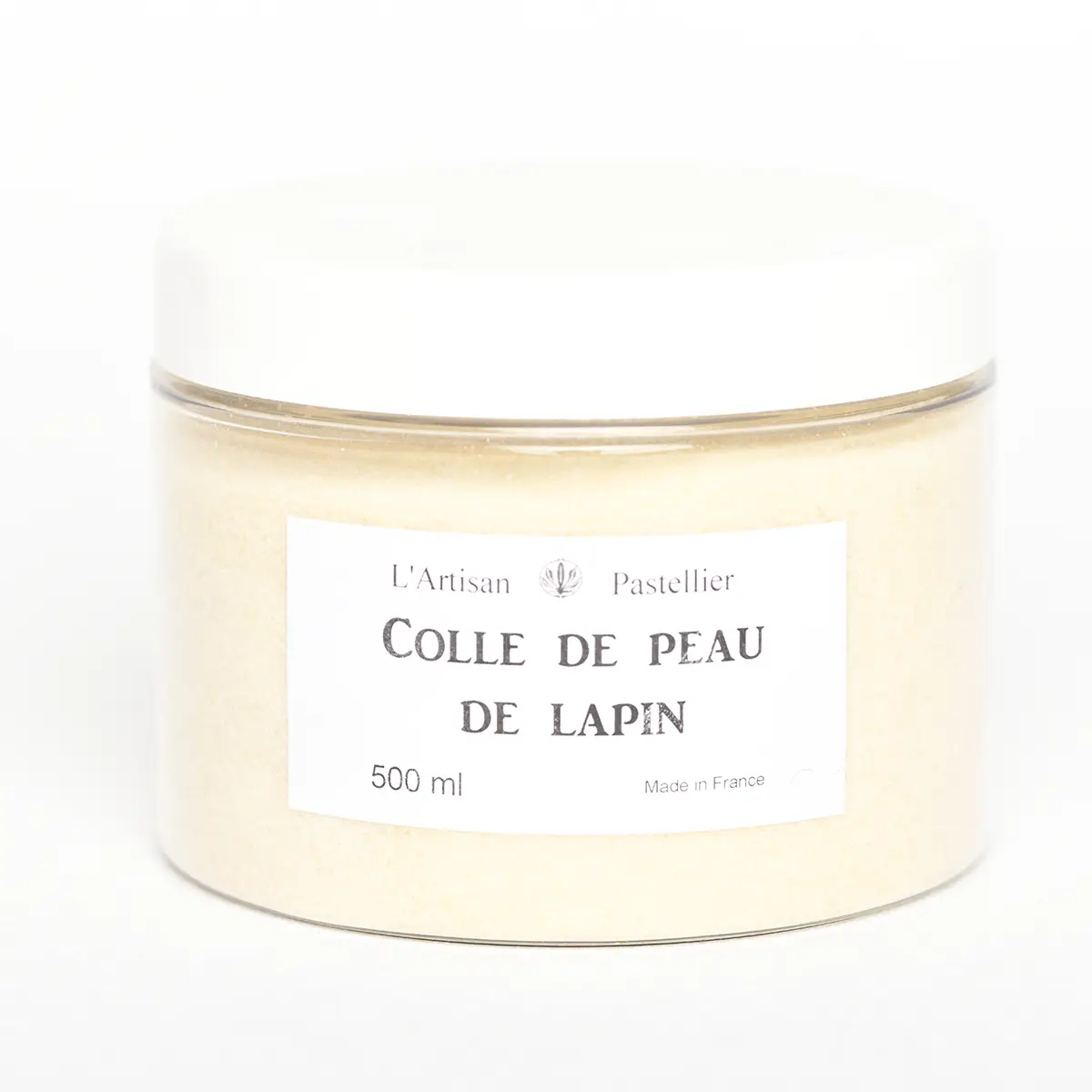
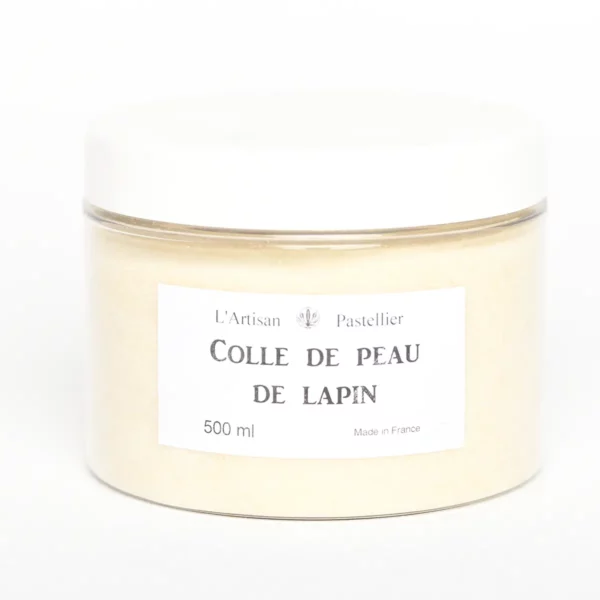
The Artisan Pastellier's Skin Glue
Price range: €12.00 to €22.00 Including tax
The Artisan Pastellier rabbit-skin glue is an organic glue of animal origin (not suitable for vegans). It is made from collagen, which gives it its great flexibility, strength, reversibility, and adhesion. This glue is purified and is a natural material.
Artisan Pastellier’s rabbit-skin glue is an organic glue of animal origin (not suitable for vegans). It is made from collagen, which gives it its great flexibility, strength, reversibility, and adhesion. This glue is purified; as a natural material, it is susceptible to bacterial contamination. For this reason, it is recommended that you prepare only the amount of glue needed each time, as the glue does not keep well over time.
Uses:
Glue: for gluing canvas, paper, cardboard, etc.
Primer and gesso: for preparing canvases before painting
Faux marble stucco: When you mix plaster with “peau de peau” glue from L'Artisan Pastellier, the setting process is slowed, allowing you to shape it, mix plasters of different colors to create the veining of marble, and mold it into shape. Once dry, it hardens to a texture that gives it the appearance of marble.
Making marbled paper: It is used to thicken water and create a smooth surface on which to place drops of ink.
Dosages:
The dosage (by weight) should be adjusted to suit your substrates or the technique you plan to use; it is advisable to conduct tests to determine the appropriate dosages.
Canvas: 35 to 45 g per liter (or 3 to 5 g per 100 g of water)
Rigid surfaces, cardboard: 60 to 90 g per liter (or 6 to 9 g per 100 g of water)
Stuck: 8 g per liter
Thickening/gel for marbled paper: 8 g per liter
Preparation of Primers and Gesso Bases
Once dry, L'Artisan Pastellier's hide glue remains supple and flexible, making it an excellent primer. To reduce the risk of bacterial growth, use perfectly clean equipment. For these high concentrations, soak the required amount of L’Artisan Pastellier hide glue overnight; the next day, gently heat it while stirring in a double boiler. Do not bring the double boiler to a boil to avoid compromising the primer’s properties.
Preparing Gesso
Pour the hot primer over Meudon white (white ground) while stirring vigorously until a frothy consistency is achieved. Let it sit for a few minutes to allow the gesso to degas before applying it. You can replace Meudon white with pigments (such as earth tones) to create a colored ground, or mix the pigment with Meudon white. Apply the gesso with a brush to the primed canvas. Once dry, sand the surface to achieve a smooth, even finish ready for painting. This process can be repeated several times, sanding each time with a finer grit to eventually achieve a perfectly smooth surface. This technique was used to prepare wooden panels during the Renaissance.
Preparation for stucco or gel.
Dissolve the exact amount of *Artisan Pastellier* animal glue needed in hot tap water while stirring.
Similar Products
-

Lemon Shellac by L'Artisan Pastellier
Price range: €12.00 to €19.90 Including tax -
Bleached, wax-free shellac from L’Artisan Pastellier
Price range: €15.00 to €24.00 Including tax -
Dammar Resin from L’Artisan Pastellier
Price range: €4.90 to €9.90 Including tax -
Rosin
Price range: €4.50 to €19.00 Including tax